
Key takeaways:
-
Green coffee bean’s moisture drops from 45–50% at harvest to 10–12% for export, making post-fermentation drying critical.
-
Industry guidance caps drying at 40°C for parchment, 45°C for cherries.
-
Commercial green coffee storage typically runs at 15–25°C and 50–70% relative humidity.
-
Sutton handles physical classification, Sortex optical color sorting, both within human-led QC.
-
CBB’s Dry Mill uses multiple checkpoints, not a single final inspection.
Green coffee beans move from roughly 45 to 50% moisture at harvest toward a 10 to 12% export target through controlled drying. This makes the post-fermentation stage crucial to final green coffee quality. While fermentation often gets the spotlight in coffee processing, it is only one part of the post-harvest chain. The stages of drying, milling, grading, sorting, storage, and final handling are the key determinants of whether the desired quality is maintained all the way to international buyers. Each stage carries its own risks, from excessive drying temperatures and unstable moisture to physical defects and inconsistent bean size. To mitigate all these risks, CBB’s Singaraja facility serves as the main supporting infrastructure where these post-harvest stages are managed through a sequence of processing and quality-control checkpoints.
The Data Points That Define Safe Drying
Temperature Limits by Process

Coffee drying process. Source: CBB
Industry guidance holds that parchment coffee should not be dried above 40°C, and natural process coffee should not exceed 45°C (Perfect Daily Grind, 2020). This is because excessive heat can affect bean structure and contribute to cracking or inconsistent roasting behavior. Drying temperature is therefore a controllable variable, not simply a matter of how long drying takes. At the Singaraja facility, post-fermentation coffee moves through controlled drying and subsequent preparation. It is where drying conditions and moisture targets are monitored and standardized handling reduces variability before milling.
Moisture Reduction as a Staged Process
Drying is a controlled progression from high moisture at harvest toward the export range, not a single event. In the initial stages, adequate airflow management, drying speed, and close monitoring are crucial when the moisture is still high. The final target connects directly to storage stability and later milling. However, reaching the number is not enough, because moisture must also be uniform throughout the lot.
Storage: Protecting Quality After Drying
Temperature and Humidity
Commercial guidance cites a storage range of approximately 15 to 25°C and 60 to 65% relative humidity (Green Coffee Beans News, 2026). This condition is crucial because green coffee is hygroscopic, so they keep responding to its surroundings even after drying, and humidity control. Therefore, humidity control is especially relevant to moisture stability and long-term quality.
What Happens Outside the Target Range
Unstable temperature and humidity can contribute to moisture migration and quality deterioration. This is because they can trigger moisture transfer within the warehouse. This creates wet spots due to air condensation. Consequently, product quality declines due to mold, pests, and chemical damage. Perfectly dried products remain vulnerable to damage if the storage area is not properly maintained. Without close monitoring, products can reabsorb water and rot during shipping by sea, leading to export rejections. Therefore, efforts to maintain product quality must continue even after the drying target is achieved.
Hulling, Grading and Color Sorting: Turning Dried Coffee Into an Export-Ready Lot
Hulling Removes the Outer Layers
Dry hulling prepares dried parchment or dried coffee into green coffee suitable for grading and export. This is more than a mechanical step, because it readies the lot for physical inspection and sorting.
Sutton Grading Machine: Physical Classification
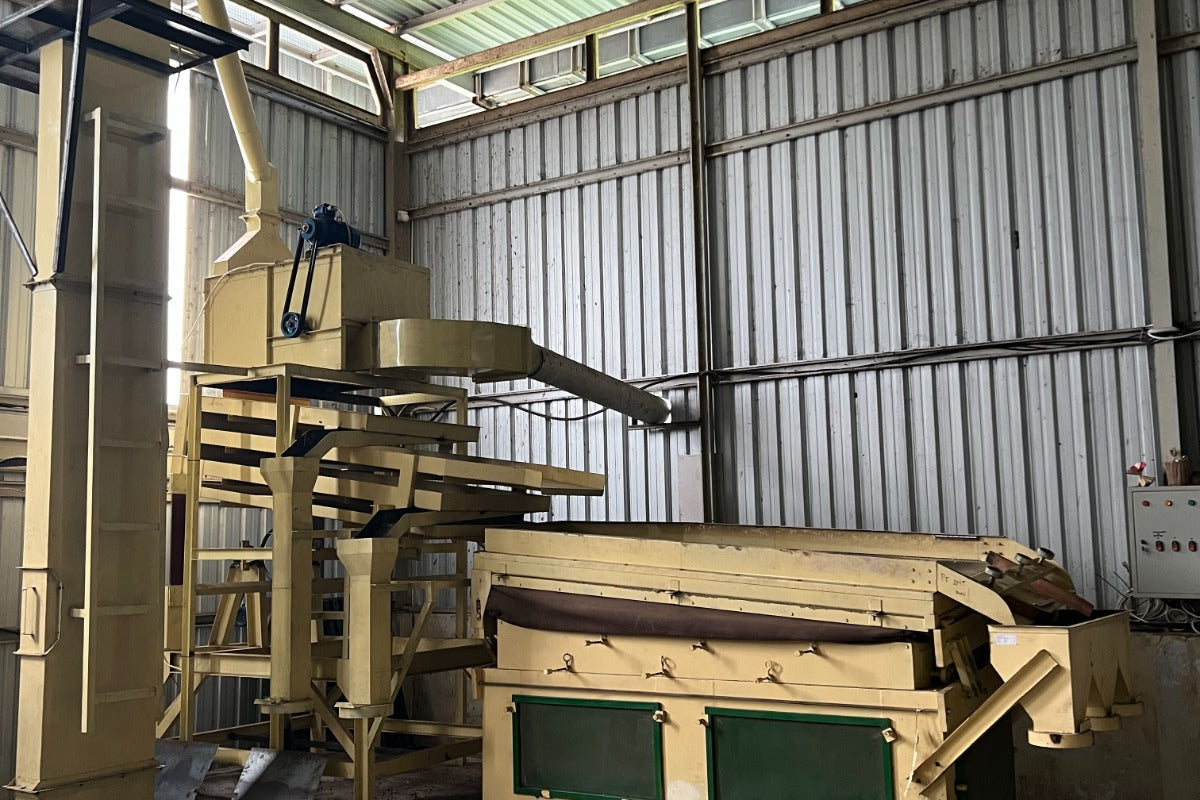
CBB uses a Sutton grading machine to separate green coffee by physical characteristics, particularly bean size and screen distribution. Tighter physical uniformity can reduce variation within a roasting batch. Mechanical grading is also more standardized for export volumes than manual visual selection alone. This machine anchors the facility’s physical grading. It supports consistent screen-size classification and preparation of coffee to agreed specifications, which directly serves buyer requirements for physical uniformity.
Sortex Machine: Color Sorting
CBB uses a Sortex machine for color sorting, adding a second sorting checkpoint after physical grading. It identifies beans whose color differs from the desired specification and separates them from the target lot. The two machines play complementary roles: the Sutton grades by size, and the Sortex sorts optically. Both operate alongside human QC and established specifications, not in place of them.
Hand Pick Sorting

Hand pick sorting at Coffee Beyond Borders. Source: CBB
Last but not least, hand-pick sorting serves as the final checkpoint. After mechanical grading and color-sorting, trained workers inspect the green coffee manually and remove any remaining defects that the machines may have missed. These defects are removed according to the specifications set in each buyer’s request. This human step complements the Sutton and Sortex machines, adding a final layer of judgment before export.
From Processing to Export
The full workflow runs: drying, moisture control, dry hulling, Sutton grading, Sortex color sorting, QC, storage, and pre-shipment verification. Multiple checkpoints give greater control than a single final inspection. This is all done in order to preserve and verify agreed specifications through to export.
Why Standardized Processing Matters More Than Individual Skill
One skilled operator can produce a good lot. Repeatable infrastructure and SOPs make quality scalable across lots and shipments. For big buyers and importers, that means repeatable specifications, more predictable physical characteristics, consistent processing across larger volumes, and easier pre-shipment verification. Buyers need reliable supply, not a single successful sample.
Conclusion
Coffee quality does not stop developing, or facing risk, when fermentation ends. Drying determines moisture stability, milling prepares the coffee for export, grading controls physical uniformity, color sorting removes visually inconsistent beans, and storage protects the result. CBB’s Singaraja facility, with its Sutton grading and Sortex color sorting, is built as a multi-stage system to support consistent, export-ready green coffee across commercial shipments.
Looking for Indonesian green coffee supported by controlled post-harvest processing and modern grading and sorting infrastructure? Connect with the Coffee Beyond Borders team through our Contact Form or WhatsApp to explore our Singaraja facility, processing capabilities, and sourcing solutions for export-ready green coffee.
References
Castellano, N. (2020, November 24). A guide to coffee drying. Perfect Daily Grind. https://perfectdailygrind.com/2020/11/a-guide-to-coffee-drying/
Wong, Y. L. (2026, January 17). How to store green coffee: Shelf life, freshness and best practices. Green Coffee Beans News. https://greencoffeebeansnews.com/how-to-store-green-coffee/
Share:
What Defines High-Quality Arabica Coffee Beans? Standards You Should Know